



Vibe coding has arrived with speed, confidence, and plenty of noise. Tools that promise to turn plain English into working interfaces have captured attention across startups, creator spaces, and early-stage product teams. For many people, that first experience feels like magic. You describe an idea. The screen responds. Buttons appear. Flows connect. Something that looks like a product comes to life in minutes.
That feeling is real. The value is real too. But the danger sits right next to the excitement.
Vibe coding is not application development. It was never meant to be. It is a fast, expressive way to prototype ideas, explore flows, and test assumptions. When teams treat it as a shortcut to building serious applications, they are not moving faster. They are laying shallow foundations that will crack under real-world use.
I am writing this as a UX consultant and as the author of AI and UX Playbook and Vibe Coding and UX Thinking. I work daily with organisations trying to untangle products that grew too quickly without structure, research, or design discipline. AI has changed how we prototype. It has not changed how real products need to be built.
This article makes one clear argument: vibe coding belongs in quick prototyping, not in full application development. Used well, it strengthens UX work. Used poorly, it creates long-term complexity that teams pay for later.
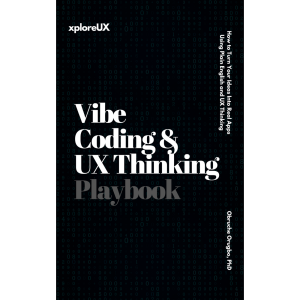

Vibe coding is not a formal engineering method. It is a behaviour. You describe what you want in natural language and let an AI system generate interface elements, flows, or even entire screens based on that description. The goal is speed, expression, and momentum.
Most vibe coding sessions share the same characteristics. There is no defined data model. There is no clear system architecture. Error states receive little attention. Accessibility rarely enters the conversation. The focus stays on what the interface looks like and how quickly something appears.
That does not make vibe coding bad. It makes it honest. It is a creative, exploratory activity.
Problems start when people confuse this creative output with a production-ready product. A clickable screen is not an application. A generated flow is not a scalable system. A working demo is not proof of long-term viability.
Buy on Amazon
The early stage of any idea is fragile. Momentum matters. Confidence matters. Vibe coding gives both.
You can test an idea before investing weeks of effort. You can show something tangible to stakeholders instead of slides. You can validate whether a flow makes sense without writing formal specifications. For UX consultants, product designers, and founders, that speed is valuable.
Vibe coding shines when the questions are still fuzzy. What should this tool do first? What language resonates with users? Which flow feels simpler? These are design questions, not engineering ones.
The danger is psychological. Once something looks real, people treat it as real. Teams start stacking features on top of a prototype that was never designed to carry weight. Decisions made casually in a vibe coding session quietly become “the way the product works.”
That is how shallow foundations form.
A prototype answers questions. A product must survive answers.
Prototypes exist to be thrown away or rewritten. They are learning tools. Products must handle edge cases, growth, failure, security, performance, and change. When teams use vibe coding outputs as the base of a real application, they reverse that logic. Instead of learning first and building second, they build first and hope learning will catch up.
This reversal shows up later as fragile systems, inconsistent behaviour, and painful rewrites. What felt fast at the start becomes slow and expensive over time.
UX professionals have always understood this difference. Paper sketches were never shipped. Wireframes were never production code. Vibe coding sits in the same family, even if the output looks more complete.
Shallow foundations do not fail immediately. That is why they are dangerous.
Applications built directly from vibe coding outputs often work fine in controlled conditions. Early users forgive rough edges. Small data volumes hide inefficiencies. Single-team ownership masks design debt.
As usage grows, cracks appear. Small changes break unrelated features. Performance degrades in unpredictable ways. Accessibility issues surface too late. New developers struggle to understand why things work the way they do.
At that point, teams face a hard choice. Patch the fragile system and accept growing complexity, or rebuild properly and absorb the cost. Either path is more expensive than doing the foundational work earlier.
This is not a failure of AI. It is a failure of judgement.
Complexity rarely comes from ambition. It comes from shortcuts taken without visibility.
When vibe coding generates UI and logic together, structure emerges implicitly. Naming conventions, data flows, and interaction rules form without shared agreement. Over time, these implicit decisions conflict with new requirements.
Design consistency suffers first. Then data integrity. Then trust. Users feel it even if they cannot articulate why. Things feel unpredictable. Errors feel arbitrary. Confidence drops.
UX consultants are often brought in at this stage, not to polish interfaces, but to untangle systems that grew without intentional design. The cost is not just financial. It is cultural. Teams lose faith in the product and in their own ability to improve it.
There is a persistent myth that AI tools reduce the need for UX consultants. In practice, the opposite is happening.
AI accelerates output. It does not replace judgement. As tools make it easier to create interfaces, the cost of poor decisions increases. When anyone can generate a flow, someone still needs to decide whether that flow makes sense for real people.
UX consultants bring structure to ambiguity. They translate user needs into design systems that scale. They ask uncomfortable questions early, when change is cheap. AI does not do that on its own.
Vibe coding makes early exploration faster. UX thinking keeps products coherent over time.
Vibe coding excels in four specific areas.
It works well for concept exploration. When an idea is still forming, speed matters more than precision. Vibe coding lets teams see possibilities quickly and discard weak ideas without emotional attachment.
It supports stakeholder alignment. Showing something interactive builds shared understanding faster than documents. Stakeholders can react to concrete flows instead of abstract descriptions.
It helps with usability testing preparation. Rough prototypes allow teams to test language, flow, and expectations before investing in production design.
It supports UX workshops. Designers and consultants can co-create with clients in real time, turning conversations into tangible artefacts that support discussion.
In all these cases, the output is disposable by design.



Vibe coding struggles as soon as stability matters.
Applications need clear data models. They need predictable states. They need consistent behaviour across contexts. They need accessibility baked in from the start, not layered on later.
AI-generated interfaces do not naturally enforce these constraints. They respond to prompts, not long-term maintenance needs. Without deliberate intervention, the system grows unevenly.
This is where traditional UX methods still matter. Research, information architecture, interaction design, content strategy, and service design provide the structure that AI does not supply by default.
UX thinking is not about screens. It is about behaviour.
Real applications sit inside messy human contexts. Users make mistakes. They multitask. They misunderstand labels. They abandon flows halfway through. Good UX design anticipates this behaviour and designs systems that respond gracefully.
Vibe coding can generate screens, but it does not observe people. It does not notice hesitation. It does not feel frustration. Those insights come from research and interpretation.
In Vibe Coding and UX Thinking, I argue that vibe coding should amplify UX thinking, not replace it. The tool accelerates expression. The thinking guides direction.
The Risk of Treating Prototypes as Products
The biggest risk is organisational, not technical.
When teams treat prototypes as finished work, learning stops. Feedback becomes harder to act on because changes feel disruptive. Early assumptions harden into rules.
This creates defensive behaviour. People protect the existing system rather than questioning it. Innovation slows, even though the product started fast.
UX consultants are often asked to “improve usability” in these situations, when the real issue sits deeper. The system was never designed to evolve.
AI Did Not Remove the Need for Design Discipline
Every major technology shift has promised to simplify product creation. Visual builders, no-code platforms, rapid frameworks all followed similar patterns. They lowered barriers, then exposed new complexity at scale.
AI fits this pattern. It changes the pace of work, not the principles.
Design discipline still matters. Clear problem definition still matters. Understanding users still matters. Decisions still need ownership.
Vibe coding is a tool. Discipline is a practice.
How Mature Teams Use Vibe Coding Safely
Mature teams set clear boundaries.
They treat vibe coding outputs as sketches, not foundations. They document insights gained from prototypes and rebuild intentionally. They separate exploration from production work.
UX consultants play a key role here. They help teams extract learning from prototypes and translate it into structured requirements, design systems, and validated flows.
This approach preserves speed without sacrificing stability.
The Cost of Ignoring Foundations
Ignoring foundations does not save money. It defers cost.
The bill arrives later as rewrites, replatforming, accessibility audits, performance fixes, and user churn. At that stage, teams wish they had slowed down earlier.
Shallow foundations feel efficient until they collapse. Deep foundations feel slower until they save you.
Why the Industry Still Needs UX Consultants
The rise of vibe coding has not reduced demand for UX consultants. It has changed the questions clients ask.
Clients now arrive with prototypes instead of ideas. They want help understanding what they built and why it feels wrong. They want clarity, not speed.
UX consultants provide that clarity. They connect tools to purpose. They turn experimentation into strategy.
AI can suggest. Consultants decide.
Reframing Vibe Coding as a UX Tool
The healthiest framing is simple. Vibe coding is a UX tool for thinking, not a shortcut for building.
When teams respect that boundary, they gain speed without confusion. When they cross it, complexity grows quietly.
Tools do not create products. Decisions do.
Vibe coding has earned its place in modern UX practice. It allows rapid exploration, shared understanding, and creative momentum. Used for quick prototyping, it strengthens design work and supports better decisions.
What it does not replace is the work of building real applications. Production systems need structure, research, and accountability. They need UX consultants who understand behaviour, not just interfaces.
If someone builds a serious application directly on vibe coding outputs, they are building on shallow foundations. It may stand briefly, but complexity will catch up. When it does, the cost will be higher than expected.
The future is not AI versus UX consultants. It is AI supporting disciplined UX thinking. Fast prototypes paired with strong foundations. Tools that accelerate learning, guided by professionals who know when to slow down.
That balance is where real products succeed.
The UX & AI Playbook: Harnessing User Experience in an Age of Machine Learning
The UX Strategy Playbook: Designing Experiences that Put Users First
The UX Consultant Playbook 1: Bridging User Insights with Business Goals
The UX Consultant Playbook 2: Crafting High-Impact Solutions
The UX Deliverables Playbook: Communicate UX Clearly & Confidently
The UX Consultant Playbook 3: Mastering the Business of UX Consulting
Vibe Coding & UX Thinking Playbook: How to Turn Your Ideas Into Real Apps Using Plain English and UX Thinking