


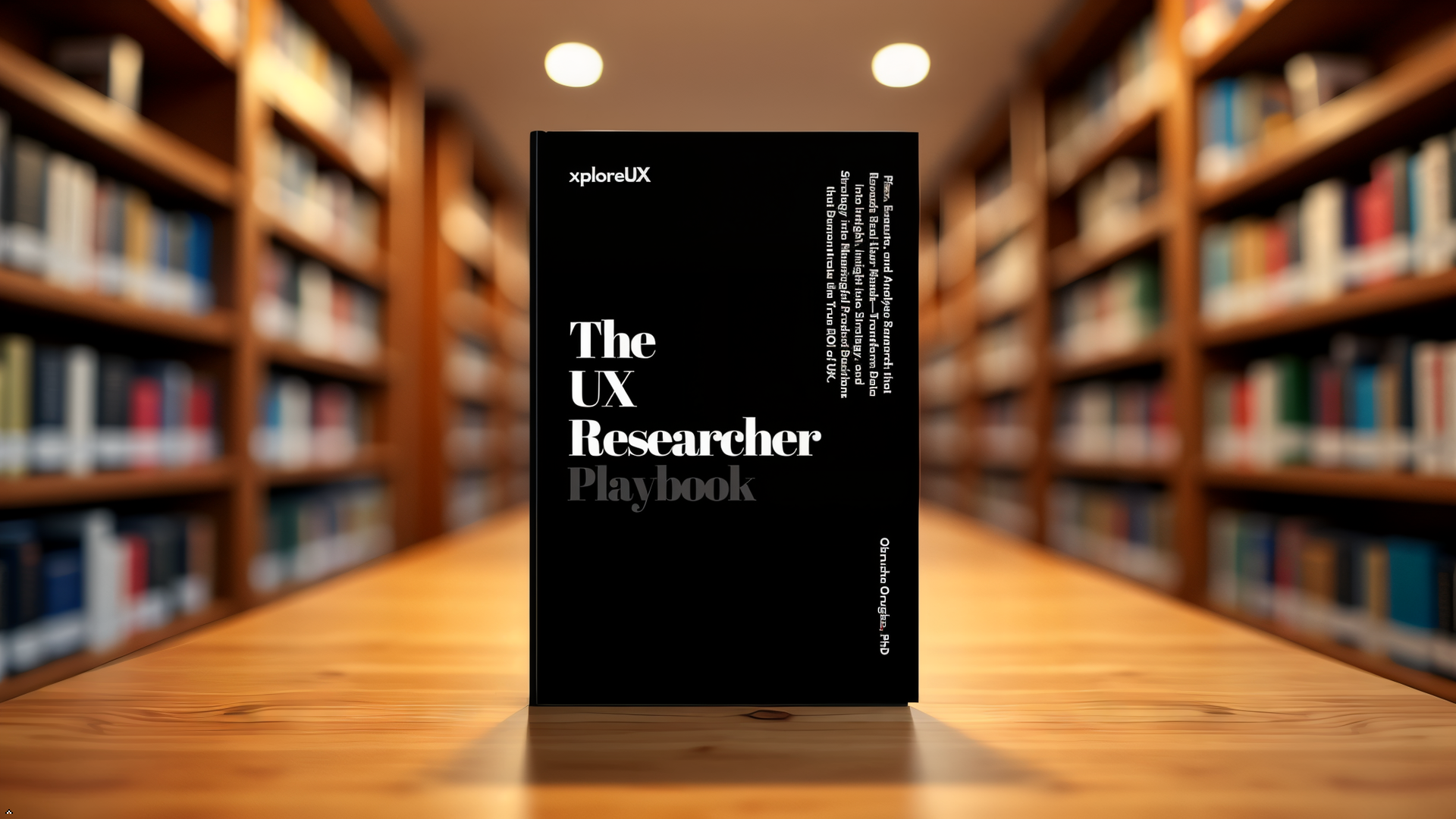
Strong products aren’t born from guesswork. They’re built on clarity, evidence, and a deep understanding of what people actually need. Whether you’re a rising UX professional, a founder shaping your first product, or a creative building digital ideas on the side, one truth holds steady:
Your decisions are only as strong as your research.
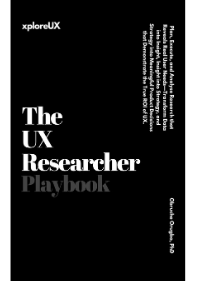
That’s why The UX Researcher Playbook: Plan, Execute, and Analyse Research that Reveals Real User Needs by Dr Obruche Orugbo, PhD is set to become an essential tool for anyone who wants to move from shallow research to work that genuinely transforms products.
This isn’t another inspirational UX book. It’s a practical, detailed system that shows you exactly how to run the kind of research that improves features, reduces waste, supports better decisions, and raises your credibility across any team.
Today, we’ll explore what makes this book powerful, who it’s for, and how it helps you grow into the researcher companies rely on for clarity.

Businesses across every sector—tech, education, healthcare, retail, finance, and public services—have reached the same realisation:
Without real insight, products fall flat.
Teams are tired of launching features nobody uses. Leaders want evidence before they commit to big decisions. Designers want clarity so they can solve the right problem instead of redesigning the same screens over and over.
You’ve likely felt this shift yourself:
- Teams now ask, “Do we have research to support this?”
- Stakeholders want faster answers that still feel grounded.
- AI tools can summarise data, but they can’t replace real human insight.
- Credibility matters more than ever.
Research is no longer a checkbox. It’s a foundation.
This is exactly where The UX Researcher Playbook steps in.
Dr Obruche Orugbo wrote this book to give UX professionals a clear, structured, repeatable process for planning, running, and analysing research at a professional standard — even if they don’t have a dedicated research mentor on their team.
Buy on Amazon

Most UX courses teach methods. Very few teach judgement — the thing that separates average researchers from trusted ones.
This book fills that gap.
- Plan research that aligns with real business goals
Too many researchers jump into choosing methods before understanding what the team is actually trying to solve. This leads to vague insights, confusion, and back-and-forth conversations that weaken your influence.
The playbook shows you how to:
- Clarify what matters most
- Translate goals into research questions
- Pick the right method based on time, skills, and constraints
- Avoid common planning mistakes that cause projects to collapse
You walk into stakeholder meetings with confidence, not uncertainty.
- Gather insight that exposes behaviour, motivations, and barriers
Anyone can ask users what they think.
Very few can uncover what people actually do — and why they do it.
This is where the book shines. You’ll learn:
- How to frame questions that reveal truth, not polite answers
- How to observe behaviour and extract meaning from it
- How to guide interviews so users speak naturally
- How to collect reliable data without leading or influencing participants
These are the research habits that set you apart.
- Analyse interviews, surveys, and usability sessions with clarity
Analysis is the skill researchers struggle with most. It feels messy, overwhelming, and easy to get wrong.
This book brings structure to the chaos by teaching you:
- How to organise raw notes
- How to identify patterns in behaviour
- How to separate signals from noise
- How to avoid bias in your interpretation
- How to turn scattered data into meaningful insights
With this process, you stop second-guessing your findings and start delivering clear conclusions teams can trust.
- Turn insights into actionable recommendations
Research only matters when it drives action.
Designers need direction. Product managers need clarity. Leadership needs insight that ties to business outcomes.
You’ll learn how to translate findings into:
- Simple recommendations teams actually use
- UX opportunities aligned with strategy
- Prioritised insights that guide roadmaps
- Measurable actions that show ROI
This is how researchers become influential — not by collecting data, but by shaping decisions.
- Communicate in a way that inspires action
Reports don’t move people. Stories do.
One of the core strengths of this book is that it teaches you how to communicate research in a way that resonates. You’ll learn:
- How to craft compelling narratives
- How to simplify complex findings
- How to present insights to busy leadership
- How to justify decisions with strong evidence
- How to avoid overwhelming teams with too much detail
If you’ve ever struggled to get stakeholders to listen — this section alone is worth the book.
One reason The UX Researcher Playbook is so valuable is because it meets people exactly where they are. Let’s break it down by your core audiences.
For Small Business Owners
Small businesses rarely have large research teams. They rely on intuition and quick decisions. This playbook helps them:
- Understand what users expect
- Reduce guesswork in product or service development
- Improve websites, apps, and customer journeys
- Avoid wasted time on features nobody wants
It gives clarity without complexity.
For Busy Mums Building Digital Ideas
Time is tight. Energy is split. But the desire to build something meaningful is strong.
This book shows how to:
- Validate ideas before building
- Run simple but effective research sessions
- Understand user motivations clearly
- Build products that feel useful from day one
It becomes a trusted guide in the early stages of digital creation.
For Gen Z Creators
Creators want speed, clarity, and strategies that fit into flexible workflows.
The playbook provides:
- A repeatable process for research
- A way to understand what audiences actually want
- Tools for improving digital products, courses, communities, and content ideas
It turns creative intuition into evidence-backed decisions.
For Startup Founders
Founders are making high-risk decisions constantly.
This book helps them:
- Avoid building features with low impact
- Shape roadmaps rooted in user needs
- Justify decisions to investors
- Build products that grow through real feedback
If a founder wants to improve product direction, this is the guide they need.
For Healthcare Professionals
Healthcare teams need clarity more than most. Lives, wellbeing, and sensitive experiences are at the centre.
The playbook supports them with:
- Methods for respectful, ethical research
- Approaches for uncovering user barriers in care journeys
- Tools to improve patient portals, onboarding, digital health platforms, and service design
It strengthens both empathy and accuracy.
For UX Professionals
This is where the book truly becomes a career asset.
You’ll gain:
- A complete research framework you can follow in any organisation
- Templates you can use immediately
- A structure you can show in interviews
- A process that strengthens portfolios
- A skillset that sets you apart from other candidates
It’s a career amplifier.
One of the most practical strengths of The UX Researcher Playbook is how clearly it explains the role of AI in modern research without overstating what these tools can do. The book shows that AI isn’t here to replace researchers — it’s here to remove the repetitive work that slows you down, so you can focus on decisions that demand human judgement.
A key example is reporting. Every researcher knows how easily this stage expands beyond the planned timeline. Cleaning transcripts, polishing quotes, organising findings, and formatting slides can take hours. The playbook breaks down this challenge through a powerful passage:
“The third major area where AI plays a clear role is reporting. This is often the stage where researchers spend more time than planned. Creating reports, cleaning quotes, organising findings, or formatting slides can consume hours. AI supported reporting tools speed this up. They can summarise transcripts, generate early drafts of findings, prepare tables, highlight themes, and produce clear summaries. They can also help you build insight libraries where past research is tagged and organised for fast access. This improves knowledge sharing, reduces duplication, and helps teams benefit from insights long after the study ends.”
It continues by showing how AI supports real-time reporting — a growing need inside fast-moving product teams:
“AI can also support real time reporting… These summaries are not final, but they help you discuss early findings with the team while the study is still fresh.”
And when it’s time to produce the final report, the book makes the balance clear:
“AI tools offer templates… They also generate visual charts, word clouds, sentiment summaries, and themes that support the narrative. The researcher still needs to refine the story, connect it to business goals, and remove unnecessary details… AI provides a starting point. The researcher provides the final judgement.”
By teaching you how to work confidently with automation while keeping human insight at the centre, The UX Researcher Playbook prepares you for the realities of 2025 and beyond — where ambition, clarity, and smart tooling come together to shape stronger research and faster decisions.
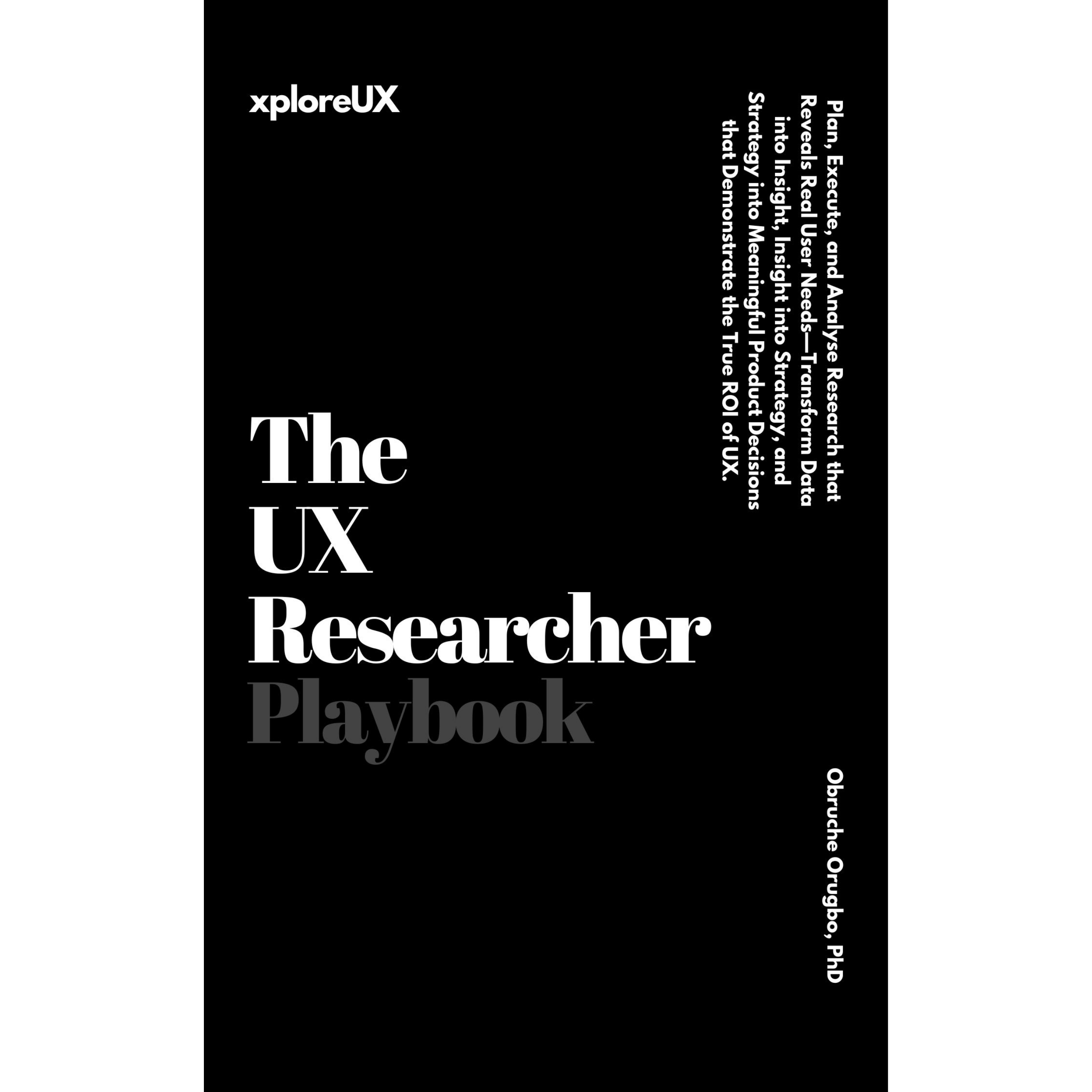
The UX Researcher Playbook: Plan, Execute, and Analyse Research that Reveals Real User Needs
Available now on Amazon
Researchers often struggle with credibility because they:
- Sound unsure in planning conversations
- Present findings that feel vague
- Deliver insights without clear recommendations
- Struggle to connect research to business outcomes
This book helps you solve all of that.
From the first chapter, you start learning how to think, plan, speak, and deliver like a trusted researcher — someone teams rely on, not someone they check in with occasionally.
Credibility comes from structure. This book gives you structure.
A Complete System for Doing UX Research the Right Way
Instead of teaching random techniques, this book takes you through the full journey of becoming a high-value UX researcher.
The table of contents alone reads like an entire university module — but written in a clear, practical way that you can apply today.
Here’s what makes this playbook different from anything else on the market.
1. A Clear Introduction to What UX Research Really Means
The opening section resets your understanding of the discipline:
-
What UX research truly is and isn’t
-
How research evolved in modern product teams
-
Where research fits within design, product, and business
-
The mindset and core competencies of a researcher
-
The full career path from beginner to expert
If you’ve ever struggled to explain the value of research, or felt unsure how your work connects to business strategy, this opening lifts that fog instantly.
You stop seeing research as isolated tasks and start understanding it as a discipline that drives alignment, reduces risk, and shapes product direction.
2. Setting the Foundation for Great Research (Chapter 1)
This chapter alone can transform how a team works.
You learn:
-
Why evidence must come before ideas
-
How to understand stakeholders and their goals
-
How the research-to-design loop works
-
How to define objectives tied to business metrics
-
The difference between generative, evaluative, and continuous research
-
When to choose qual vs. quant
-
How to scope and prioritise research requests
-
When not to research (rarely taught but crucial)
If you’ve ever felt overwhelmed by messy requests, unclear goals, or stakeholder pressure, this chapter gives you a framework to stay grounded and credible.
3. Planning UX Research Like a Professional (Chapter 2)
Research planning is where most researchers either stand out or lose trust.
This chapter shows you how to:
-
Translate business questions into solid research goals
-
Write clear research hypotheses
-
Pick the right method every time
-
Craft questions that reveal behaviour (not opinions)
-
Plan for ethics, consent, and GDPR
-
Recruit the right participants
-
Set timelines, budgets, and deliverables
-
Work confidently with designers, PMs, and developers
-
Run research kick-off meetings that establish alignment
Once you master planning, you become the person teams rely on for clarity — even before research starts.
4. Discovering Real User Needs Through Generative Research (Chapter 3)
This section teaches you the research that happens before ideas are formed.
You’ll learn how to conduct:
-
Contextual inquiry
-
Field studies
-
Ethnographic interviews
-
Diary studies
-
Longitudinal studies
Plus:
-
How to map journeys that reveal hidden pain points
-
How to identify unmet and latent needs
-
How to synthesise complex qualitative data
-
How to validate insights before design starts
If you’ve ever struggled to move beyond feature requests, this chapter teaches you how to uncover the root cause of problems, not just the symptoms.
5. Conducting Interviews That Reveal Truth (Chapter 4)
Interviews are one of the most common research methods — and one of the most commonly misused.
This chapter teaches you:
-
How to structure interviews for depth
-
How to build rapport authentically
-
How to manage bias
-
The types of questions that uncover truth
-
How to avoid leading participants
-
How to capture evidence effectively
-
How to analyse themes
-
How to involve stakeholders
-
How to turn quotes and stories into persuasive insight
Mastering interviews is how you shift from collecting polite answers to uncovering patterns teams can act on.
6. Usability Testing & Evaluative Research (Chapter 5)
Great research doesn’t end when design starts; it continues through development.
This chapter covers:
-
When to run usability tests (concept, prototype, live)
-
How to define success metrics
-
How to run moderated and unmoderated sessions
-
How to test remotely with confidence
-
How to analyse task success and errors
-
How to turn observations into design direction
-
How to report findings clearly
-
How to run iterative testing cycles
If you want to improve product quality, streamline user journeys, and support designers effectively, this chapter becomes a daily reference.
7. Surveys, Analytics, and Quantitative Methods (Chapter 6)
Numbers tell powerful stories — when used correctly.
You’ll learn how to:
-
Design unbiased surveys
-
Measure satisfaction with CSAT, SUS, NPS
-
Analyse data using simple statistics
-
Work with analytics tools
-
Use heatmaps and behavioural data
-
Triangulate quant + qual findings
-
Determine sample size and significance
-
Present data visually
If you want to balance qualitative depth with quantitative evidence, this chapter gives you that capability.
8. Making Sense of Data: Analysis & Synthesis (Chapter 7)
Analysis is the hardest skill in UX research.
This chapter makes it clear, structured, and repeatable.
You’ll learn how to:
-
Turn raw data into clarity
-
Run affinity mapping
-
Use coding techniques
-
Use AI tools for transcription and analysis
-
Distil patterns from complexity
-
Cluster insights
-
Avoid confirmation bias
-
Write compelling insight statements
-
Create recommendations teams trust
-
Build evidence-based design principles
This is where you become more than a data collector — you become a sense-maker.
9. Communicating and Influencing with Research (Chapter 8)
Research only matters when it influences decisions.
This chapter teaches you how to ensure it does.
You’ll learn:
-
How to create insight reports people actually read
-
How to tell stories with data
-
How to present findings persuasively
-
How to build dashboards and libraries
-
How to tailor messages for executives, designers, and engineers
-
How to run insight workshops
-
How to get buy-in for design changes
This chapter elevates your presence across the organisation.
10. ResearchOps: Scaling Research in Real Teams (Chapter 9)
Most organisations struggle with consistency and quality.
ResearchOps fixes that.
You’ll learn how to:
-
Build scalable systems
-
Manage participant panels
-
Handle consent and privacy
-
Create toolkits
-
Manage knowledge and repositories
-
Use AI to automate tasks
-
Establish governance
-
Onboard new researchers
If you work in a growing team, this chapter is gold.
11. Cross-Functional Collaboration (Chapter 10)
You don’t work alone.
This chapter strengthens your partnerships.
You’ll learn how to:
-
Partner effectively with designers, PMs, and engineers
-
Manage expectations
-
Facilitate reviews
-
Translate research into business language
-
Work in agile environments
-
Embed research in sprints
-
Build empathy across teams
This section makes you a collaborative force, not a siloed practitioner.
12. Advanced Methods for Professional-Level Research (Chapter 11)
Here’s what sets this book apart: it doesn’t stop at basics.
You’ll learn:
-
A/B testing
-
Eye tracking and biometrics
-
Card sorting and tree testing
-
Benchmarking
-
Service design research
-
Co-creation
-
Prototype validation
-
Accessibility testing
-
Evaluating cognitive and emotional load
You become a full-spectrum researcher, capable of choosing the right method at the right time.
13. Strategic Research and Business Impact (Chapter 12)
This is where you evolve from researcher to strategic partner.
You’ll learn how to:
-
Move from insights to strategy
-
Create research roadmaps
-
Prioritise opportunities
-
Partner with leadership
-
Measure ROI
-
Build the case for investment
-
Communicate research value to executives and boards
-
Shape company culture through insight
This is the chapter that elevates your entire career.
14. The Future of UX Research and AI Integration (Chapter 13)
AI isn’t replacing researchers — but it is transforming research.
You’ll learn:
-
How AI is changing modern practice
-
How to use AI for recruitment, analysis, and reporting
-
How to manage bias
-
How to build hybrid roles
-
How to future-proof your career
Essential reading for staying relevant.
15. Becoming a UX Research Leader (Concluding Chapter)
The final chapter focuses on your long-term growth.
You’ll learn how to:
-
Build influence beyond deliverables
-
Mentor others
-
Shape research culture
-
Continue growing as a professional
-
Leave a legacy of insight-driven design
This book doesn’t just teach skills.
It shapes identity.
A lot of UX content online gives fragments — one method here, one template there. It’s scattered.
This book gives you:
✔ A complete end-to-end system
✔ Clarity on how and why each step matters
✔ Confidence to run research without supervision
✔ A process you can use your entire career
You’re not guessing. You’re following a proven method written by someone with research, academic, and industry experience.



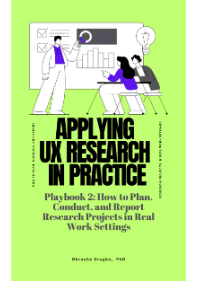
UX roles are becoming more competitive.
Teams expect stronger thinking.
Stakeholders want evidence.
If you want to stand out, you need a system that consistently produces high-quality research — not just polished portfolios or pretty UI screens.
This playbook gives you:
- A method to rely on
- A way to grow your confidence
- A process you can apply in any product environment
- The thinking style of a strong researcher
- The credibility that leads to new roles, promotions, or consulting opportunities
Your skills grow. Your influence grows. Your opportunities grow.
The UX Researcher Playbook is more than a book — it’s a partner for your UX journey.
If you want to:
- Stop second-guessing your research
- Deliver insights that move teams
- Strengthen your professional identity
- Build products based on clarity instead of assumptions
- Raise your confidence as a researcher
- Create lasting impact with your work
…this is the resource you buy now and keep referring to for years.
Get your copy today and take the next step in your UX career:
Amazon link: The UX Researcher Playbook: Plan, Execute, and Analyse Research that Reveals Real User Needs. The UX Deliverable Playbook & Vibe Coding & UX Thinking
The UX Researcher Playbook: Plan, Execute, and Analyse Research that Reveals Real User Needs
Available now on Amazon
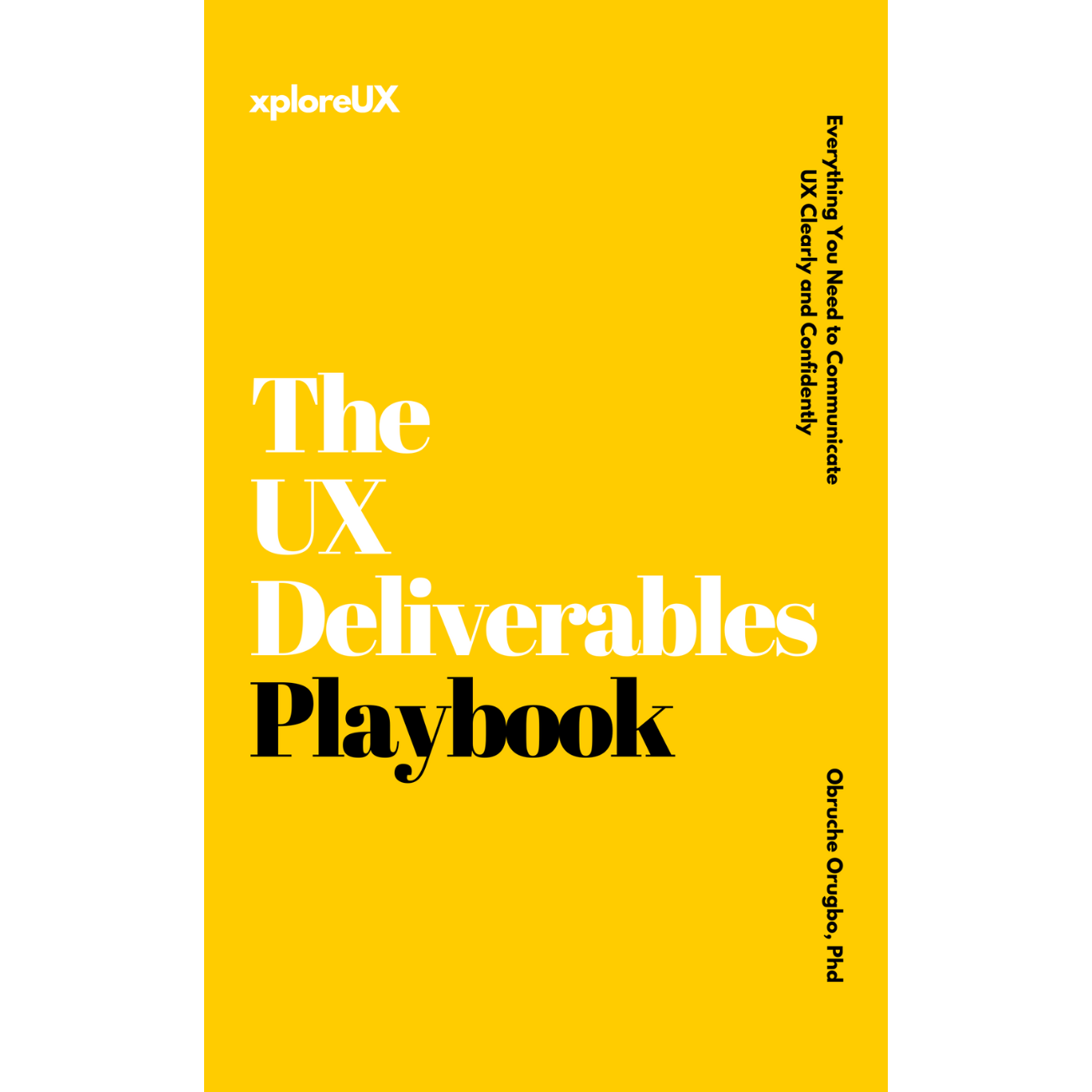
The UX Deliverables Playbook: Everything You Need to Communicate UX Clearly and Confidently
Available now on Amazon
Your best work starts with better insight.
This playbook shows you how to create it.
To explore UX strategy, research methods, and AI-supported workflows that can help you grow, visit:
Our Services
UX Consulting
Join Our Newsletter
The UX & AI Playbook: Harnessing User Experience in an Age of Machine Learning
The UX Strategy Playbook: Designing Experiences that Put Users First
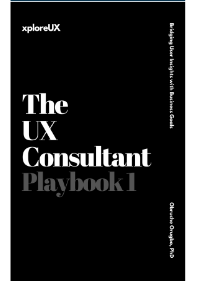
The UX Consultant Playbook 1: Bridging User Insights with Business Goals
The UX Consultant Playbook 2: Crafting High-Impact Solutions
The UX Deliverables Playbook: Communicate UX Clearly & Confidently
The UX Consultant Playbook 3: Mastering the Business of UX Consulting
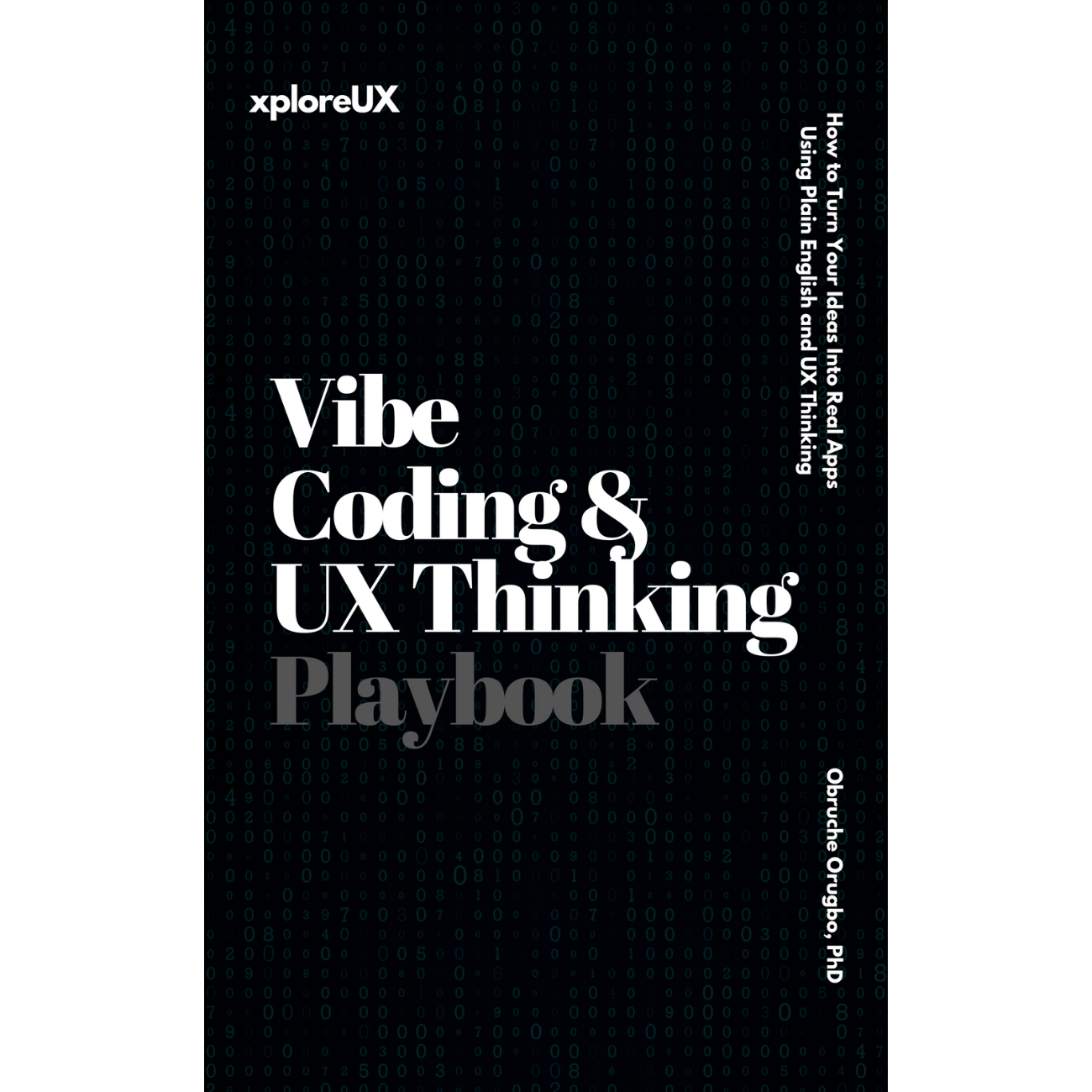
Vibe Coding & UX Thinking Playbook: How to Turn Your Ideas Into Real Apps Using Plain English and UX Thinking

![The UX & AI Playbook [Audiobook]](https://xploreux.com/wp-content/uploads/2025/12/The-UX-AI-Playbook-AUDIOBOOK-COVER-1024x1024.png)

1 comment
This has been a really wonderful post. Many thanks for providing these details.