



When you look at digital products that feel clear, friendly, and intuitive, you’re seeing the result of deliberate choices rooted in the foundations and purpose of UX strategy. Every strong product or service—whether it’s a booking app, a healthcare portal, a small business website, or a creator’s digital course—depends on decisions that put people first. The foundations and purpose of UX strategy guide these decisions with clarity, so you don’t rely on guesswork or copy what competitors do.
Many business owners and creators struggle because they jump into design too quickly. They pick colours, buttons, and features before understanding what people actually need. The foundations and purpose of UX strategy keep you grounded. They stop you from rushing ahead and help you shape experiences that make users feel seen, supported, and confident. That’s why understanding the foundations and purpose of UX strategy benefits every group you serve—busy mums who want easy flows, founders who need clarity, Gen Z creators who move fast, healthcare workers who manage heavy workloads, and UX professionals building thoughtful products.
This topic matters because real users don’t care about features; they care about outcomes. They care about how quickly they can get something done, how reassured they feel, and whether your product fits into their day. The foundations and purpose of UX strategy help you align your choices with the outcomes that matter.
By the end of this article, you’ll understand how the foundations and purpose of UX strategy shape your vision, support your business goals, and help you build experiences that are not only attractive but also helpful and trusted. You’ll see how this thinking applies to your daily work and how it creates long-term growth.
Let’s break it down in a way that’s simple, practical, and ready to apply today.



The foundations and purpose of UX strategy exist to bring clarity to product decisions. Without strategy, teams build based on assumptions, opinions, or trends that don’t last. Strategy turns uncertainty into direction.
Here’s what that looks like in real life:
- A small business owner plans a new website but feels unsure about what to prioritise. The foundations and purpose of UX strategy guide them to focus on user goals before visuals.
- A hospital department introduces new software. Staff feel overwhelmed. When teams apply the foundations and purpose of UX strategy, they rethink the flow so clinical tasks take fewer steps.
- A Gen Z creator wants to launch a digital tool. Using the foundations and purpose of UX strategy, they define what users expect before building anything.
UX strategy isn’t only for big tech teams. Anyone who interacts with customers benefits from it. When you understand the foundations and purpose of UX strategy, you spot gaps early, reduce rework, and build with confidence rather than fear.
A key part of this foundation is alignment. Strategy helps you balance three things:
- User needs
- Business goals
- Practical constraints
Think of it as a triangle. If one point fails, the whole structure wobbles. The foundations and purpose of UX strategyhelp you keep that balance steady so decisions are intentional, not reactive.
Buy on Amazon
A solid strategy feels like a calm structure behind the scenes. You may not see it, but you feel it through the ease of the experience. When teams apply the foundations and purpose of UX strategy, the final product feels smoother because decisions come from insight, not impulse.
Here’s what strong UX strategy looks like:
Clear user understanding
You know who you’re designing for and what they want to achieve. This insight anchors every decision. Without this step, features become scattered.
Simple priorities
The foundations and purpose of UX strategy help you select what matters most. Instead of trying to build everything at once, you define a focused path.
A roadmap that supports action
A good strategy guides design, content, development, and testing. It keeps everyone moving in the same direction.
Consistency
Users trust products that behave the same way across pages, tasks, and touchpoints. The foundations and purpose of UX strategy promote this consistency.
Adaptability
This is where many teams fall short. Markets shift. Expectations rise. The foundations and purpose of UX strategyensure you can adapt without losing your core direction.
Real examples:
- A startup founder builds a minimum viable product with fewer features but more clarity because the foundations and purpose of UX strategy highlight what users value most.
- A busy mum running an online shop simplifies her checkout process, increasing sales.
- A healthcare team reduces patient errors by redesigning workflows.
The thread linking all these wins is the same: strategy first.
The foundations and purpose of UX strategy aren’t theoretical—they show up everywhere. If you run a business, create content, design interfaces, or interact with customers, you’re already applying pieces of UX strategy. The goal now is to use it intentionally.
For small business owners
It helps you understand why users leave a page, struggle to book an appointment, or stop mid-checkout. Knowing the foundations and purpose of UX strategy gives you a way to fix these issues with clarity.
For busy mums building digital side-hustles
Strategy helps you build in a way that respects your time. You stop guessing and start using focused, user-centred decisions.
For Gen Z creators
Your audience moves fast. The foundations and purpose of UX strategy help you keep experiences simple, engaging, and clear.
For startup founders
It reduces risk and saves money. You avoid building features people don’t want.
For healthcare professionals
Your tools need to reduce stress, not add to it. The foundations and purpose of UX strategy help you redesign clinical tasks and information flows.
For UX professionals
It strengthens your decision-making. You communicate value with confidence.
Everyday UX is everywhere—booking systems, online courses, shopping platforms, hospital tools, fitness apps, school portals, and more. The foundations and purpose of UX strategy help you make every interaction smoother.
UX Strategy is a structured plan that focuses on the well-being of individuals who interact with products, services, and systems. Its aim is to guide organisations in tailoring offerings that speak directly to customers’ desires, challenges, and aspirations, while also promoting growth and commercial achievement. Because people’s expectations keep changing, there is a need for a deliberate and flexible approach that can adapt, staying relevant as the market environment evolves. UX Strategy concentrates on merging business objectives with the hopes and preferences of those who encounter a brand’s digital or physical touchpoints, ensuring that decisions are shaped by genuine insight rather than guesswork.
In many sectors, the quest for better engagement, customer loyalty, and operational efficiency continues to drive innovation. For years, product-focused strategies dominated, often overlooking what individuals truly felt when using an offering. The shift towards a user-centred mindset began as a response to frustration arising from products and platforms that were confusing, inconsistent, or not truly attuned to what people needed. Introducing UX Strategy, therefore, was the logical progression in aligning business activities with the evolving demand for more empathetic, inclusive, and effective experiences.
UX Strategy entails looking beyond visuals or surface aesthetics. While a visually appealing interface may get initial attention, genuine loyalty and trust develop when an organisation understands what motivates individuals, how they navigate digital platforms or physical services, and what encourages or dissuades them during their journey. In this sense, UX Strategy integrates the overarching goals of a business with well-researched user insights, turning these insights into practical steps for design, development, and communication.
This aligns perfectly with the foundations and purpose of UX strategy, giving you a structured, proven method to make decisions that actually resonate with users.

Here’s a simple framework you can apply today using the foundations and purpose of UX strategy:
- Clarify the user’s goal
Write down what real users want to achieve. Keep it short.
- Map the user journey
Highlight key steps. Look for friction points.
- Define success for the business
Match user value with business value. This is the heart of the foundations and purpose of UX strategy.
- Prioritise
Pick the top three issues that create the biggest impact.
- Test early
Create small tests—mock-ups, prototypes, surveys, or quick interviews.
- Review and adapt
Return to the foundations and purpose of UX strategy whenever you improve or expand your product.
This framework works whether you’re polishing a homepage, designing a new product, or fixing your onboarding flow.
Even experienced teams slip at times. Here are the mistakes that block progress:
Mistake 1: Skipping research
You can’t rely on assumptions. The foundations and purpose of UX strategy rely on insight.
Mistake 2: Focusing on visuals too early
A polished interface can still confuse people. Strategy first, visuals later.
Mistake 3: Building everything at once
This leads to clutter and fatigue. Use the foundations and purpose of UX strategy to guide your priorities.
Mistake 4: Ignoring feedback
User reactions must shape your direction.
Mistake 5: Not reviewing the strategy
Markets change. Your strategy must stay alive.
If you already know the basics, these deeper insights will help you refine your approach:
- Use behavioural patterns
Study how people naturally move through screens. Align your choices with proven behaviour patterns.
- Strengthen cross-team alignment
Share the foundations and purpose of UX strategy with everyone—designers, developers, marketers, and ops teams. Strategy fails when it lives in a silo.
- Build for accessibility from day one
This expands your reach and earns user trust.
- Build modular components
Reusable design parts improve consistency and reduce workload.
- Track your decisions
Document why choices were made. It helps future improvements stay aligned with the foundations and purpose of UX strategy.
Understanding the foundations and purpose of UX strategy gives you a powerful advantage. You stop building in the dark and start shaping experiences that serve real people. Whether you’re running a small business, juggling family life, creating digital products, leading a start-up, improving healthcare systems, or working as a UX professional, this clarity changes everything.
The foundations and purpose of UX strategy help you identify what matters, remove friction, and build with confidence. You avoid wasted time, avoid expensive mistakes, and build experiences people trust. Strategy reminds you that every click, every message, and every decision should help users move forward—not confuse them or slow them down.
If you want long-term growth, this is the mindset to develop. Return to the foundations and purpose of UX strategywhenever you plan, create, or redesign anything. It keeps your work focused, grounded, and meaningful.
If you’re ready to take the next step and bring sharper UX thinking into your product or business, xploreUX can support you with strategy, research, and experience design.
The UX & AI Playbook: Harnessing User Experience in an Age of Machine Learning
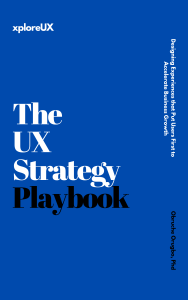
The UX Strategy Playbook: Designing Experiences that Put Users First
The UX Consultant Playbook 1: Bridging User Insights with Business Goals
The UX Consultant Playbook 2: Crafting High-Impact Solutions
The UX Deliverables Playbook: Communicate UX Clearly & Confidently
The UX Consultant Playbook 3: Mastering the Business of UX Consulting